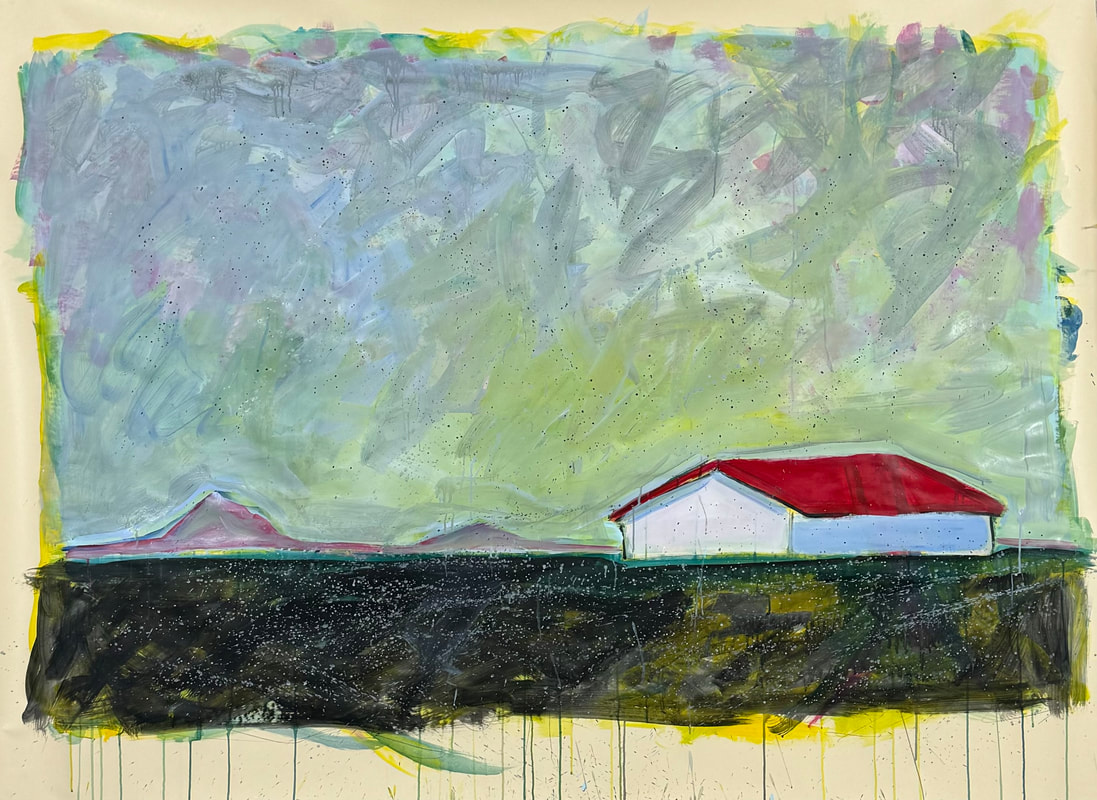
I am a Los Angeles-based multimedia artist, working as both an oil painter and a film and television production designer. My creative journey began at the University of Washington, where I was fortunate to be mentored by the renowned artist Jacob Lawrence. Lawrence's influence was transformative: he not only inspired a deep love for painting but also a reverence for manual skills and the discipline of craft.
Lawrence's legacy endures in my practice, which is grounded in a formalist appreciation of line, shape, color, composition, and space. Spatial design is often at the heart of both my painting and production design. The way we inhabit and perceive space frames our emotional and narrative experiences—whether on canvas or celluloid. In both disciplines, space becomes a conduit for exploring relationships: between artist and viewer, memory and imagination.
That conduit has carried a consistent set of concerns across three decades of painting: the body under pressure, fragmented, multiplied, withheld, or fused with something not quite itself. I return often to repetition—a face stamped from the same woodblock, a figure painted several times within one frame—because it lets a single identity become an echo rather than a likeness. I return just as often to absence: a withheld head, a body reduced to fragments, an object standing in for what's too difficult to show directly.
Recently, my studio has become both the subject and structure of my work. The exposed studs and crumbling plaster of my 19th-century Lincoln Heights studio—situated in Los Angeles' first suburb, originally settled by Italian immigrants—provide a visual and conceptual framework for my paintings. Just as the bones of the building are revealed, my paintings are "constructed" through gestural brushwork, dynamic color contrasts, and unique spatial relationships, allowing the hand of the artist to always be evident in the final piece of work.
My most recent series, Harsh Beauty, brings this to the surface directly—grids that are windows and cages in the same breath, structures that confine and structures that let the light in. I have come to believe those were never two different things, on canvas or off it.
This conceptual overlap—between the built world of a film set and the constructed surface of a painting—now inspires my pursuit of a symbiotic relationship between painting and design: two practices that have always been, for me, the same act of staging a space for something to be seen and felt.
Lawrence's legacy endures in my practice, which is grounded in a formalist appreciation of line, shape, color, composition, and space. Spatial design is often at the heart of both my painting and production design. The way we inhabit and perceive space frames our emotional and narrative experiences—whether on canvas or celluloid. In both disciplines, space becomes a conduit for exploring relationships: between artist and viewer, memory and imagination.
That conduit has carried a consistent set of concerns across three decades of painting: the body under pressure, fragmented, multiplied, withheld, or fused with something not quite itself. I return often to repetition—a face stamped from the same woodblock, a figure painted several times within one frame—because it lets a single identity become an echo rather than a likeness. I return just as often to absence: a withheld head, a body reduced to fragments, an object standing in for what's too difficult to show directly.
Recently, my studio has become both the subject and structure of my work. The exposed studs and crumbling plaster of my 19th-century Lincoln Heights studio—situated in Los Angeles' first suburb, originally settled by Italian immigrants—provide a visual and conceptual framework for my paintings. Just as the bones of the building are revealed, my paintings are "constructed" through gestural brushwork, dynamic color contrasts, and unique spatial relationships, allowing the hand of the artist to always be evident in the final piece of work.
My most recent series, Harsh Beauty, brings this to the surface directly—grids that are windows and cages in the same breath, structures that confine and structures that let the light in. I have come to believe those were never two different things, on canvas or off it.
This conceptual overlap—between the built world of a film set and the constructed surface of a painting—now inspires my pursuit of a symbiotic relationship between painting and design: two practices that have always been, for me, the same act of staging a space for something to be seen and felt.